Compare ScrumDo

Most tools solve one layer of the problem. ScrumDo keeps the layers connected.

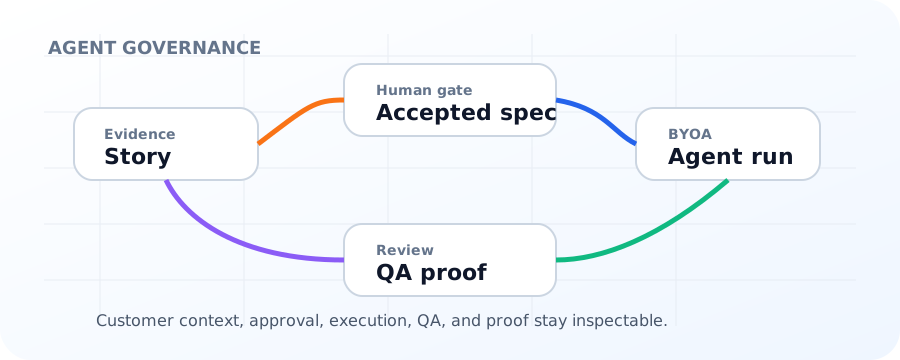
One tool tracks the work. Another holds the knowledge or the customer stories. Almost never the same one. ScrumDo keeps the signal, the spec, the flow, and the outcome in one place, for your people and the agents they bring.

Two product views side by side with a fair checklist between them, comparing work tools on capability not marketing

Best entry points

Compare feature by feature, on price, or by the job you hold.

Two tables do most of the work: where ScrumDo keeps layers connected, and how it prices against the field. Then jump to an in-depth page for Jira, Linear, Asana, Monday, SwiftKanban, Azure DevOps, or Atlassian Rovo, or use the tables for everything else.

Empirical flow forecasting with Little’s Law and Monte Carlo replays shaping predictability

Flow metrics and forecasting tools

When the forecast lives in a layer beside the work

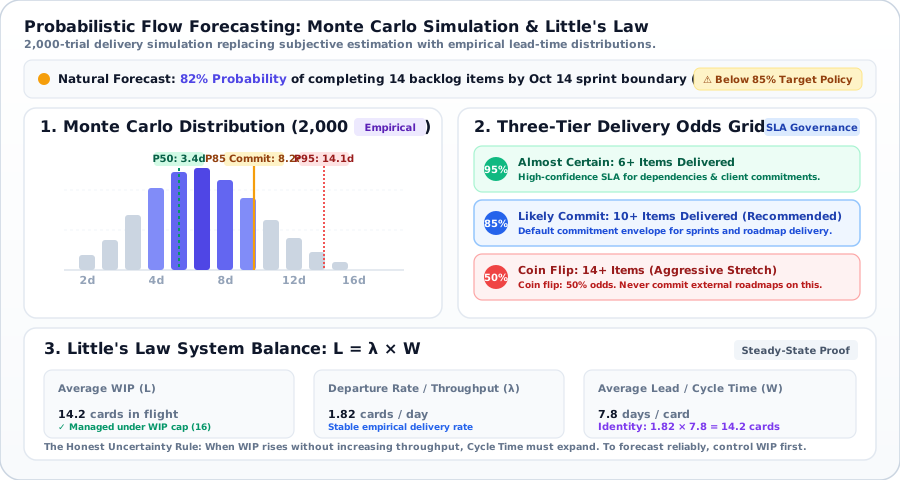
Dedicated flow tools forecast well, cumulative flow diagrams, lead-time histograms, Little’s Law and Monte Carlo. The question is whether that forecast sits next to the customer signal, the economics, and the agents, or in a separate analytics layer.

Documents and notes turning into accountable work cards

Knowledge and workspace tools

When documents need to become accountable work

Plenty of teams start in docs, notes, and flexible databases. The wall shows up when the work gets harder and the source of truth splits in two.

Research stories with signifiers staying attached to insight

Research and insight tools

When insight should stay attached to the work

Research tools are good at gathering and synthesizing evidence. The harder question is what happens after the insight is clear.

Portfolio hierarchy with budget and work contracts linked together

Portfolio and strategic planning tools

When the portfolio layer still sits too far above the work

Strategic portfolio and enterprise alignment tools live here. Start here when the real question is whether signal, budget, and work contracts can sit on the same cards instead of three systems apart.

Scaled planning canvas with programs, dependencies, and delivery aligned

Scaled Agile (SAFe) tools

When the SAFe layer sits above the real work

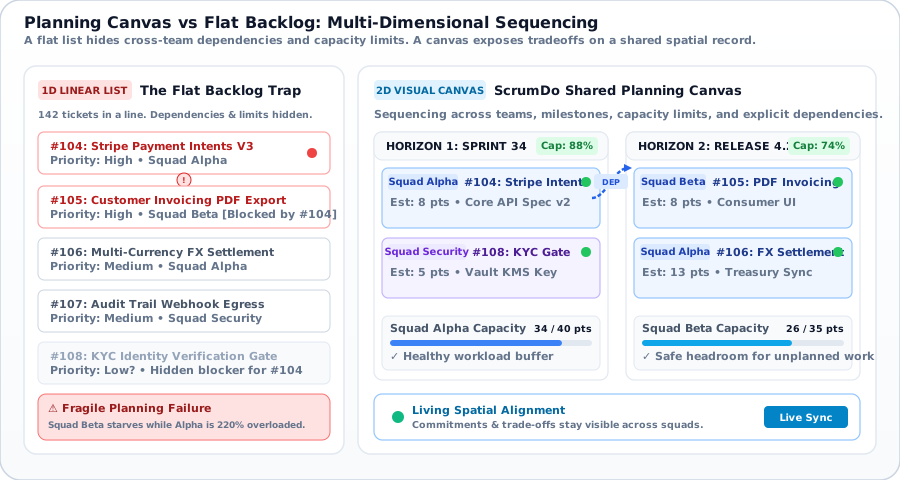
Enterprise SAFe platforms coordinate portfolios, programs, and teams well. The question is whether the customer signal, the cost-of-delay economics, the flow forecast, and the agents live on the same work, or in an alignment layer above it. ScrumDo also supports SAFe, but keeps those layers on the card.

Bring-your-own agents working from an accepted spec under human control

AI agent platforms

When the question is how agents should work

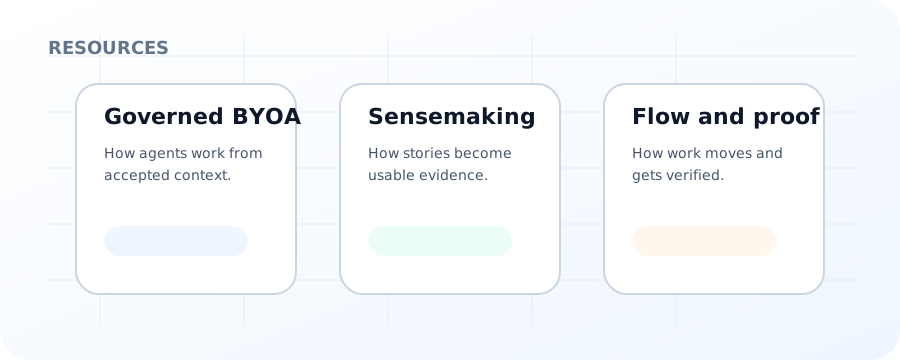
Suites like Atlassian Rovo now ship capable AI agents wired into their own tools and data. ScrumDo takes a different stance: it is not another agent. It runs the agents you already pay for (Claude, Codex, Grok, Copilot, Cursor) off one accepted spec, under human control, with no lock-in to a single suite. Read this page when the real question is whether agents should work from an accepted spec rather than inside one vendor’s walls.

Feature by feature

What ScrumDo keeps connected that point tools leave apart.

Most categories solve one layer well. This is the layer-by-layer view of where ScrumDo is built differently, with a guide behind every row.

CapabilityTypical toolsScrumDoGo deeper
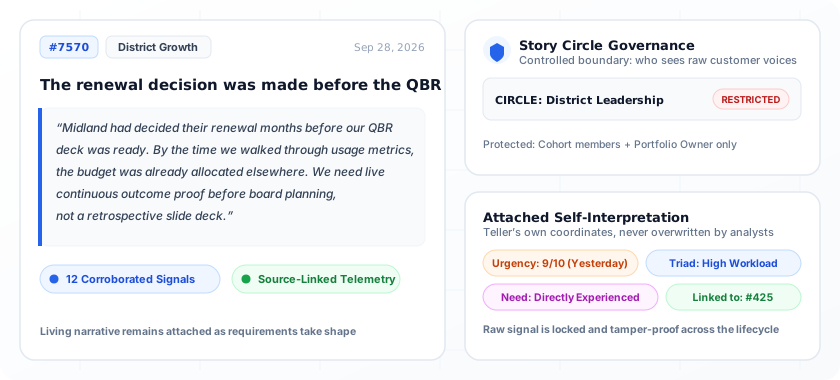
Customer signal that survives into the workCaptured in a separate intake, research, or docs tool, then summarized before it reaches delivery.Self-interpreted customer stories stay source-linked on the card that becomes the work.From stories to wiser next steps →
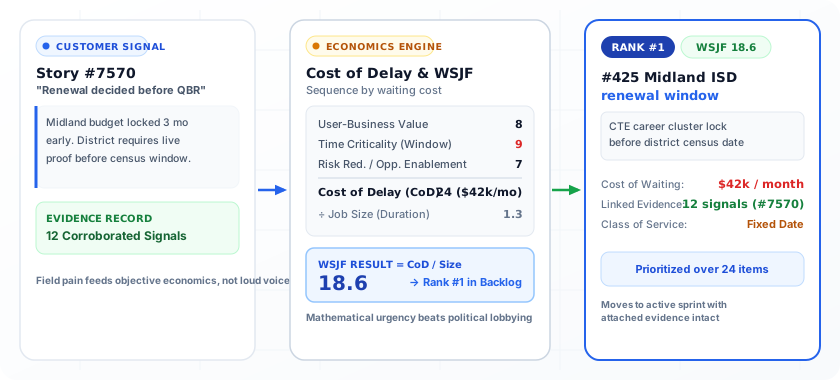
Economic prioritization (cost of delay, classes of service)WSJF often lives in a separate roadmap tool or a custom field, rarely tied to cost of delay or a live service policy on the delivery record.Cost of delay and classes of service shape the queue, with the economics next to the decision.Cost of Delay for everyday prioritization →
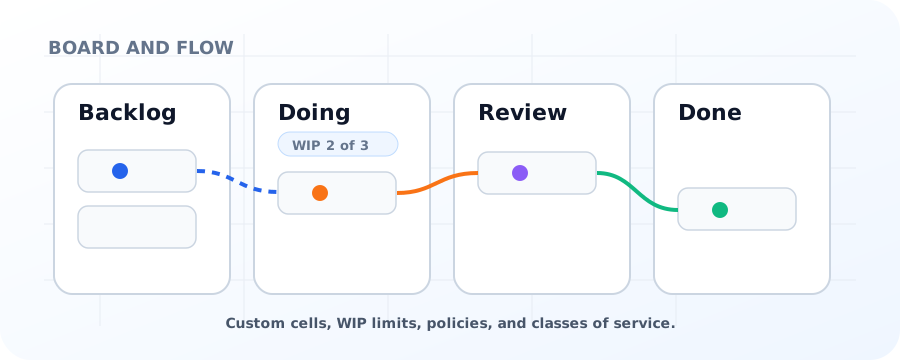
Flow that is not a straight line (WIP limits, Little’s Law)Straight-line kanban columns with, at most, a single max-WIP cap per column.Designed boards with min/max, horizontal, person, work-type, and class-of-service WIP limits that match how the work really moves.Flow is not a straight line →
Delivery forecasting from real flow (Little’s Law, CFD, histogram)Velocity charts, or probabilistic forecasting only through paid marketplace add-ons.A built-in Little’s Law forecasting tool turns filtered CFD, lead-time histogram, and throughput into a defensible date range — on Team and above.Plan with flow metrics, not hope →
Evidence and outcomes you can trustDashboards that look impressive but float away from the stories and values behind the work.Reports rooted in the same stories, values, and timestamps tracked throughout, not a separate metrics layer.Reports and outcomes rooted in evidence →
Bring your own agent, under human controlNative suite agents or per-seat AI add-ons, usually scoped to that vendor’s own data.Connect the agents you already pay for to a governed card-spec with proof, on your compute, with $0 markup.Governing AI agents with human wisdom →
Learning at scale (probes, task maps, governed agent roles)One-off experiments tracked manually, with no shared structure to clone across teams.Probe definitions as task maps that clone across teams, with governed agent roles supporting learning at scale.Learning probes for service teams →
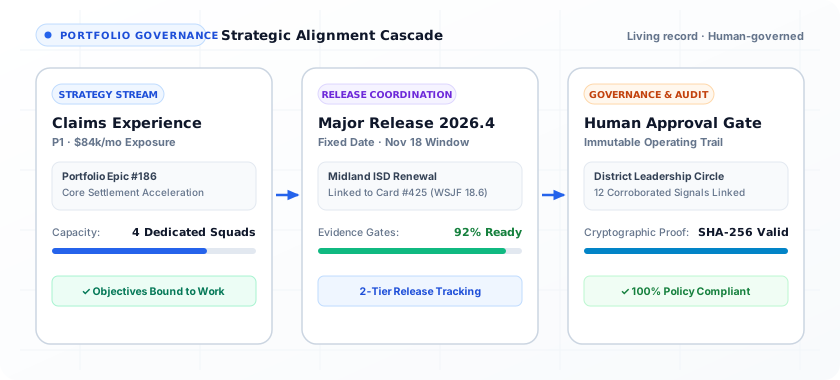
Portfolio budget attached to real workA strategy or PPM layer that sits above the work and reconciles back to it later.Budget, economics, and release structure ride on the same cards the teams actually deliver.Portfolio budgeting with the work still attached →
Price across the board

How ScrumDo prices against the field.

List pricing as of mid-2026; check each vendor for current rates. ScrumDo Personal, Team, and Business are available now with assisted onboarding. Team is $29/mo billed annually (2 Crew + 1 Manager); Business is $119/mo billed annually (8 Crew + 2 Managers). Governed BYOA agents carry $0 markup, because your AI provider bills tokens directly.

ToolTheir pricingScrumDoWhere ScrumDo compares well
WrikeTeam $9.80/user/mo; Business $24.80/user/mo; Enterprise $45+/user/moTeam $29/mo (3 seats); Business $119/mo (10 seats + $12/Crew)Wrike Business costs $24.80/user/mo for custom workflows and request forms. ScrumDo provides living specs, DORA, Wardley Maps, OKRs, and Governed BYOA at 46%–68% lower TCO.
JiraFree up to 10 users; Standard $7.91/user/mo; Premium $14.54/user/mo (annual)Personal $99/yr or $9.99/mo; Team $29/mo includes 2 Crew + 1 Manager, then $7–$9 per CrewClose on raw seats, but Jira’s Rovo AI is a $20/user/mo add-on; ScrumDo’s governed BYOA agents carry $0 markup.
LinearFree (unlimited members, 250 issues); Basic $10/user/mo; Business $16/user/mo (annual only)Personal $99/yr or $9.99/mo; Team $29/mo (2 Crew + 1 Manager); Business coming soonLinear is cheap for pure issue tracking; ScrumDo adds customer signal, economics, and BYOA agents with no per-seat AI tax.
AsanaFree up to 10; Starter $10.99/user/mo; Advanced $24.99/user/mo (annual)Team $29/mo (2 Crew + 1 Manager); Business coming soonScrumDo Team has transparent bundled pricing. Business will add portfolio economics and reviewable portfolio decisions when it launches.
MondayFree (2 seats); Basic $9, Standard $12, Pro $19 per seat; 3-seat minimum, sold in bucketsTeam $29/mo includes 2 Crew + 1 Manager, add seats one at a timeMonday bills in seat buckets, so a 4-person team pays for 5; ScrumDo adds exact seats and never resells AI.
NotionFree; Plus $10/user/mo; Business $20/user/mo (AI only in Business)Team $29/mo (2 Crew + 1 Manager) with governed BYOA agents includedNotion AI requires the $20 Business tier per seat; ScrumDo’s BYOA agents carry $0 markup—your provider bills tokens.
ProductboardSpark $15/maker/mo (annual) with 250 AI credits; Enterprise customTeam $29/mo; Business portfolio economics coming soonPriced per maker for discovery; ScrumDo keeps customer signal attached through delivery, not in a separate tool.
Aha!No free plan; Roadmaps Premium $59/user/mo; Enterprise $99–$149/user/mo (annual)Business portfolio economics coming soonScrumDo is preparing a Business tier that keeps portfolio economics attached to the work rather than separating planning from delivery.
Jira Product DiscoveryFree; Standard ~$10/creator/mo (contributors free)Team $29/mo carries signal into delivery and economicsCheap for discovery alone; ScrumDo keeps the signal alive through prioritization, flow, and outcomes.
DovetailFree up to 3 editors; Professional ~$39/editor/mo; Enterprise custom (often $40k–$55k+/yr)Team $29/mo; Business coming soonA research repository priced per editor; ScrumDo keeps evidence on the work instead of in a separate archive.
QualtricsQuote-based annual contracts; no public per-seat pricePublished Personal and Team pricing; Business coming soon; Enterprise by reviewAn enterprise experience platform; ScrumDo publishes pricing for the Personal and Team work-and-signal layers.
PlanviewQuote-based enterprise PPM; no public per-seat priceBusiness coming soon; Enterprise by reviewEnterprise PPM priced by sales; ScrumDo publishes Personal and Team pricing and keeps budget on the actual work.
Jira AlignQuote-based enterprise; no public per-seat priceBusiness coming soon; Enterprise by reviewA SAFe alignment layer above delivery; ScrumDo’s portfolio rides on the same cards teams deliver from.
ServiceNow SPMPlatform/quote-based enterprise; no public per-seat priceBusiness coming soon; Enterprise by reviewPlatform-priced and heavy to roll out; ScrumDo publishes Personal and Team pricing and attached to live work.
Broadcom ClarityQuote-based enterprise PPM; no public per-seat priceBusiness coming soon; Enterprise by reviewEstablished PPM priced by sales; ScrumDo connects portfolio economics to the work as it happens.
Atlassian Rovo$20/user/mo AI add-on on Jira/Confluence (bundled in some plans)Governed BYOA agents included from Team ($29/mo), $0 markupRovo is a per-seat AI add-on on top of Jira/Confluence licensing; ScrumDo runs the agents you already pay for on your own keys, with $0 markup.
SwiftKanbanFree (10 users, 3 boards); Group $7/user/mo; Enterprise $15/user/mo (annual); ESP and Story Mapping add-ons $15/user/mo eachPersonal $99/yr or $9.99/mo; Team $29/mo (2 Crew + 1 Manager); Business coming soonSwiftKanban has deep flow analytics and forecasting too; ScrumDo keeps that flow data next to self-interpreted customer evidence, cost-of-delay sequencing, and governed BYOA agents — no per-user add-ons for the full scope.
Nave$100/board/mo or $1,000/board/yr (unlimited users); no free tier, 14-day trialFlow forecasting built in from Team ($29/mo); no per-board feeNave is a flow-analytics add-on for Jira/Trello/Azure; ScrumDo builds the same Little’s Law, CFD, and lead-time forecasting into the board, so you don’t pay per board for a separate layer.
ClickUpFree; Unlimited $7/user/mo; Business $12/user/mo (annual); Enterprise custom; ClickUp Brain AI +$9/user/moPersonal $99/yr or $9.99/mo; Team $29/mo (2 Crew + 1 Manager); Business coming soonClickUp is a broad all-in-one; ScrumDo trades breadth for flow economics, evidence-linked stories, and governed BYOA agents with $0 AI markup instead of a per-seat AI add-on.
SpiraPlanConcurrent-user licensing (unlimited named users): ~$2,424/yr (3), ~$7,583/yr (10), ~$41,324/yr (100); on-premise availableBusiness coming soon; Enterprise by reviewSpiraPlan is a full ALM/SAFe suite with end-to-end traceability; ScrumDo is lighter and keeps signal, economics, flow, and agents on the work rather than a separate requirements and test estate.
Azure DevOps (Boards)First 5 users free, then $6/user/mo Basic; Basic + Test Plans $52/user/mo; free for Visual Studio subscribersPersonal $99/yr or $9.99/mo; Team $29/mo (2 Crew + 1 Manager); Business coming soonAzure DevOps is excellent value for the Microsoft delivery toolchain and SAFe-capable backlogs; ScrumDo adds the decision layer — customer signal, cost-of-delay economics, built-in flow forecasting, and governed BYOA agents — above the code.
Rally (Broadcom)Quote-based enterprise; free Digital BizOps Starter for up to 50 users (no support)Business coming soon; Enterprise by reviewRally is a mature enterprise SAFe platform priced by sales; ScrumDo publishes Personal and Team pricing and keeps signal, economics, flow, and agents on the work.
Apptio TargetprocessQuote-based, ~$30–$60/user/mo (often 25-user minimum); e.g. ~$40,500/yr for up to 125 usersBusiness coming soon; Enterprise by reviewTargetprocess is a highly configurable SAFe/portfolio platform tied to IT financials; ScrumDo is opinionated and decision-first with published Personal and Team pricing and forecasting built into the board.
Digital.ai AgilityQuote-based enterprise (Essentials/Pro/Premium); commonly ~$50/user/mo and up, plus onboardingPersonal $99/yr or $9.99/mo; Team $29/mo; Business coming soonAgility (formerly VersionOne) gates predictive analytics to its Premium edition; ScrumDo builds Little’s Law flow forecasting into the board from the first paid tier and adds governed BYOA agents.

Competitor pricing is summarized from public list pricing and changes often, so verify on each vendor’s site. Enterprise and quote-based tools do not publish per-seat rates.

Keep the best human signals in the loop.

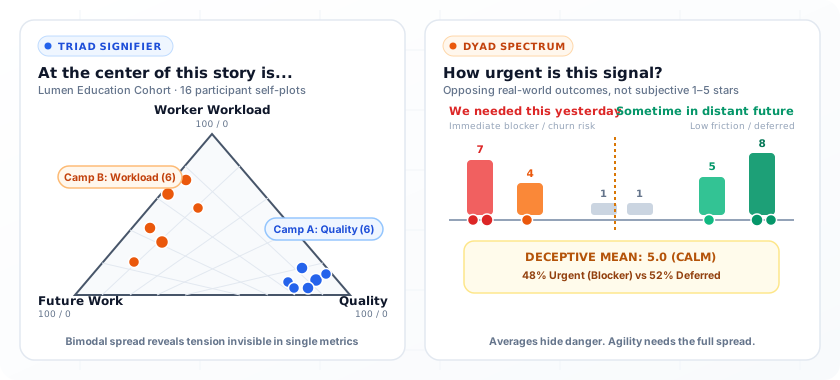
The strongest signals still come from customers, staff, and stakeholders close to the work. ScrumDo keeps that signal on the card long enough to change what the team does next.

Cards are more than tickets.

A card can hold the working spec, the context behind the work, the blockers affecting it, the automation around it, and the outcome trail that follows.

Flow is not a straight line.

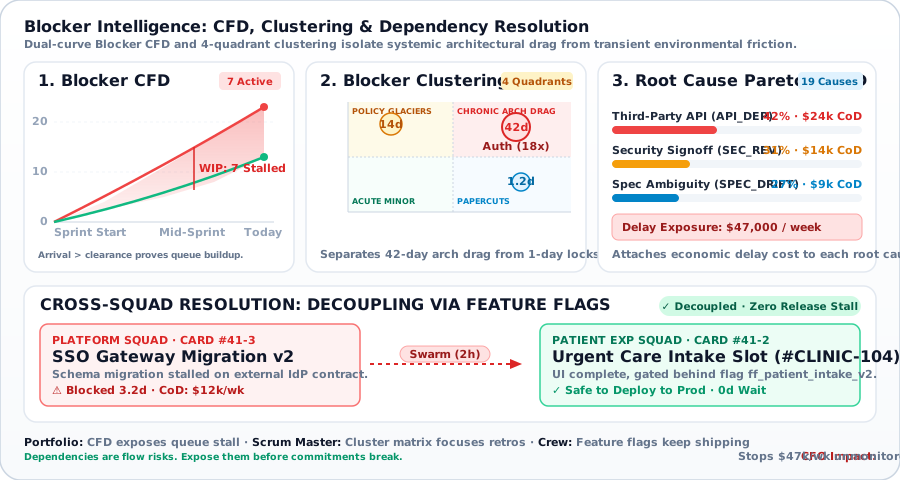
Real work branches, stalls, loops back, and reconverges. ScrumDo reflects that reality with flexible workflows, WIP limits, blockers, and stronger flow visibility.

Humans and agents work from the same truth.

Your team and your BYO agents can work from the same card-spec instead of splitting work across tickets, docs, and prompts.

For engineering and product teams

Move beyond issue execution

Start with Jira, Linear, Jira Product Discovery, and Productboard if the problem is that planning and execution have drifted too far apart.

For cross-functional teams

Move beyond broad coordination

Start with Asana, Monday, and Notion if the problem is that the work looks organized but the signal, blocker, and outcome layers are still disconnected.

For research and portfolio teams

Move beyond repository-only insight

Start with Dovetail, Qualtrics, Aha!, and Productboard if the problem is that the evidence is clear but the work system still loses it on the way to delivery.

For portfolio, SAFe, and transformation leaders

Move beyond a detached strategy layer

Start with Planview, ServiceNow SPM, and Clarity for portfolio judgment, or the SAFe estate, Azure DevOps, Jira Align, Rally, Targetprocess, Digital.ai Agility, when the framework aligns programs but signal, budget, and the actual work keep drifting apart.

For teams choosing how to run agents

Orchestrate agents, don’t bet on one

Read the ScrumDo vs Atlassian Rovo page when you want agents that act from accepted specs under human control. Suites increasingly bundle their own agents; ScrumDo keeps your right to bring whichever agent you already pay for, instead of locking into one vendor’s autonomy.

Start by role

Pick the comparison path that matches the job you hold.

Different buyers hit different limits first. These paths are here to shorten the comparison work instead of asking every team to read every page.

Kanban board with cards moving through columns and a blocker being cleared

For engineering leaders

When issue execution is no longer the whole problem

Start with the tools most likely to be strong on delivery speed but weaker on signal, specs, and broader flow coordination.

Cross-functional task coordination with blockers and dependencies visible

For operations and service leaders

When the work looks organized but still does not move cleanly

Start with broad coordination tools if the real pressure is now blocker visibility, service discipline, and a more truthful flow model.

Business path

If the comparison is really about portfolio judgment, jump to the page built for that problem.

The compare hub helps you evaluate tools. The Business portfolio page explains why ScrumDo’s upper tier exists and when it becomes the better fit.

Start by problem

Use the comparison path that matches the tension in the work.

If you already know where the friction is, start there instead of reading by category alone.

If the flow breaks

The board is clean but the work still stalls, branches, or loops

Use these comparisons when the visible workflow looks healthy while the real operational drag is still hiding underneath it.

If the forecast breaks

The flow charts are great but live in a layer beside the work

Use these comparisons when forecasting, CFD, and lead-time analytics are strong but disconnected from the signal, economics, and agents doing the work.

How to use these comparisons

Start with the job your current tool is doing.

Do not compare every page. Start with the cluster that matches the pressure your team is actually under right now.

Look for where the signal breaks.

The key question is not feature count. It is where customer context, specs, blockers, and outcomes stop staying attached.

Use pricing only after the fit is clear.

Team pricing should keep the friction low. The higher tiers should only matter once you can see what they buy you.